You've been doing everything right on social media.
Your posts go out consistently—Facebook here, Instagram there, maybe even some LinkedIn and TikTok. You're showing up, you're engaging, and slowly but surely, your follower count is climbing.
For many businesses, this consistency used to be the hardest part. Coming up with fresh content ideas every single day? Exhausting. Scheduling posts across different platforms? Time-consuming. Staying on brand without repeating yourself? A real challenge.
That's why tools like Woopsocial have become so valuable. They take the guesswork and grunt work out of social media management—generating a full month of on-brand posts in minutes, scheduling them across all major platforms, and keeping your accounts active even when you're busy doing actual work. What used to take 10+ hours a week can now be done in about 30 minutes.
It's brilliant. It works. And it frees you up to focus on other things.
But here's the question that still needs answering: What are your social media followers supposed to do next?
People are liking your posts. They're commenting. Sometimes they even DM you asking, "How much is this?" or "Do you have this in stock?"
So why isn't the cash register ringing?
If this sounds familiar, you're not alone. Thousands of businesses have figured out the first half of the game: getting attention. But the second half—turning that attention into actual sales—still feels like a mystery.
Let's talk about what happens after the post goes live.
The 10-Hour Problem You Already Solved
First, give yourself some credit.
Social media management used to be a full-time job. Researching content ideas. Writing captions. Finding the right images. Scheduling posts. Engaging with comments. Repeat every single day.
For a small business owner, that's easily 10+ hours a week—time you could have spent on product development, customer service, or actually selling.
Tools that automate social media content have been a game changer. They let you:
- Generate a month's worth of posts in minutes
- Maintain consistent branding across platforms
- Schedule everything to publish at optimal times
- Keep your accounts active even when you're busy
It's brilliant. It works. And it frees you up to focus on other things.
But here's the question that still needs answering: What are your social media followers supposed to do next?
The Missing Link: From "Nice Post" to "I'll Take It"
Let's walk through a typical customer journey.
A potential customer scrolls through Instagram. They see your post—maybe it's a beautiful photo of your product, a behind-the-scenes video, or a customer testimonial.
They're interested. They click through to your profile.
And then... they hit a wall.
Maybe they send a DM asking for prices. Maybe they comment "How to order?" Maybe they just scroll away because the next step isn't obvious.
This is what marketers call the conversion gap. You've done the hard work of getting their attention. But you haven't made it easy for them to buy.
Think about it from their perspective:
- They don't want to wait hours for you to reply to a DM
- They don't want to scroll through your feed trying to find a price list
- They don't want to screenshot items and type out orders manually
- They definitely don't want to fill out long forms on a slow website
They want what they always want: fast, easy, familiar.
What Happens After the Scroll
Around the world, there's one thing that's become familiar to almost everyone: messaging apps.
Whether it's WhatsApp, Messenger, or Telegram, people have moved away from emails and phone calls. They want to interact with businesses the same way they interact with friends—through quick, casual chats.
Think about the last time you needed to ask a shop about a product. Did you call them? Send an email? Or did you just send a message?
Exactly.
So if your social media is working hard to bring people to your brand, but your sales process still involves typing out "Price is $25, shipping is $5, here's our payment details..." over and over again... there's a disconnect.
Your automated social media is saving you 10 hours a week. But manual order-taking might still be eating up another 10.
The Complete Picture: Attention + Action
Here's what a seamless customer journey looks like in 2026:
Step 1: Attract
Your automated social media tool posts consistently. Your audience grows. People see your content every day. They know you exist. They like what you offer.
Step 2: Engage
A follower sees something they want. They click the link in your bio. Instead of landing on a confusing website or a blank chat window, they land on something useful.
Step 3: Convert
They browse your products easily—prices visible, descriptions clear, photos sharp. When they're ready to buy, they tap a button. Their entire order (every item, every option) is automatically formatted and sent to you via their preferred messaging app. No back-and-forth. No "sorry, which color again?" No manual typing.
Step 4: Deliver
You receive a clean, complete order. You confirm, pack, and ship. Happy customer. Repeat business.
This is what "completing the customer journey" actually looks like.
Why Both Halves Matter
Here's the thing: attention without action is just vanity.
Having 10,000 followers means nothing if those followers can't easily buy from you. A post that goes viral means nothing if people don't know how to order.
On the flip side, having a great ordering system means nothing if nobody knows you exist.
That's why the smartest businesses are starting to think in terms of systems that work together:
- One system to handle social media presence (so you stay top-of-mind without spending all day posting)
- One system to handle catalog and orders (so when people are ready to buy, the process is effortless)
They're not competitors. They're teammates.
Tools That Play Nicely Together
This is where things get interesting.
If you're already using an AI-powered social media scheduler like Woopsocial to keep your content consistent, you're halfway there. Your brand is showing up. People are noticing.
Now imagine pairing that with a simple, mobile-friendly catalog tool.
When someone DMs you asking "Do you have this in blue?", you don't have to type a paragraph. You don't have to scroll through your photos. You just send them a link.
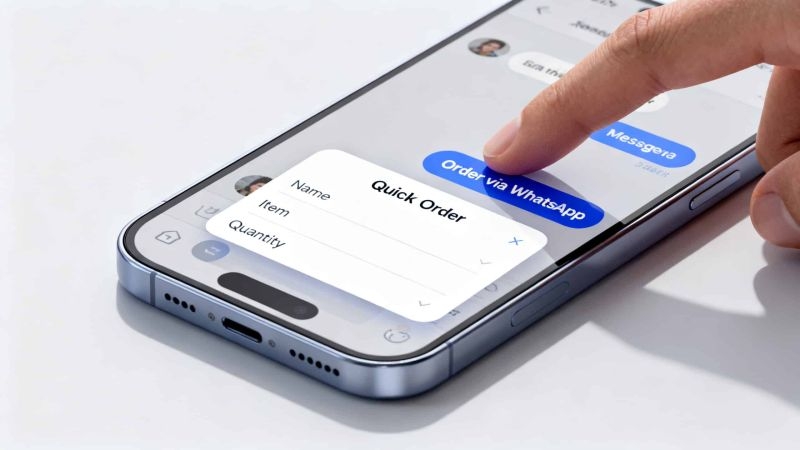
They open it. They see your full catalog—organized, updated, professional. They find what they want. They tap "Order via WhatsApp" (or Messenger, or whichever app you use). A complete order message pops up, ready to send. They hit send. You receive it.
That's it.
No friction. No confusion. No lost sales because the customer got tired of waiting for a reply.
The Bottom Line
Social media gets their attention.
Your catalog closes the sale.
One without the other is like having a megaphone with no one to listen, or a store with no sign out front. Both matter. Both need to work.
The businesses that are growing fastest right now aren't the ones with the most followers. They're the ones who have figured out how to turn a follower into a customer without making them jump through hoops.
So here's a question to think about:
If your social media is bringing you 100 interested people this week, how many of them will actually become customers?
And more importantly: what would happen if that number doubled?
P.S. This is actually why tools like WhatsMenu exist—to handle the second half of that journey. A simple, always-updated catalog that connects directly to WhatsApp and other messaging apps. Customers browse, tap, and send their order in one go. You receive clean, ready-to-process orders without the back-and-forth. Perfect for businesses that have already figured out the social media part and just need the sales part to catch up. 😊