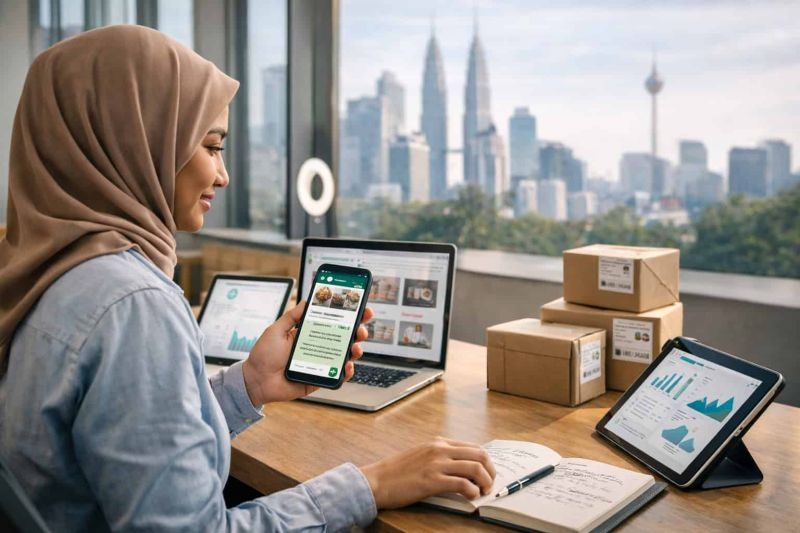
Let me ask you something.
How many times do you open WhatsApp in a day?
Five? Ten? Or does your hand just automatically reach for your phone every time it buzzes?
Now let me ask you another question.
How many times do your customers open WhatsApp?
Same answer.
In Malaysia, WhatsApp stopped being "just a chat app" a long time ago. It's where families check in on each other. It's where friends plan their weekend kopitiam meetups. And it's where your customers decide whether to buy from you.
Nearly 90% of Malaysians use WhatsApp. It has quietly overtaken email as the go-to communication channel for SMEs.
But here's the real question: are you just chatting on WhatsApp, or are you actually using it to sell?
Why You Need to Take WhatsApp Sales Seriously in 2026
Let's look at what's actually happening on the ground.
Bata Malaysia launched something called "ChatShop." It lets customers check shoe stock at their nearest store, place orders, and pay—all through WhatsApp. Then they pick up or get delivery the same day. Their projection? This feature alone could drive 5% revenue growth.
Then there's Lamarsa Coffee, one of Malaysia's biggest coffee equipment retailers. They upgraded WhatsApp from a casual chat tool to a proper sales channel. Result? Quarterly sales jumped 50%. Response time improved by 38%. And leads increased by 10 times.
These aren't tech giants. These are brands you see in malls around Malaysia.
What did they do right?
Simple. They realized something: instead of dragging customers to a platform they don't know, go to where your customers already are.
The Three Levels of WhatsApp Selling: Which One Are You On?
Not all WhatsApp is the same. Meta (the company behind WhatsApp) actually built three different tiers for different types of businesses. Figuring out which one you need is half the battle.
Level 1: WhatsApp Business App (Entry Level)
This is what most small Malaysian businesses are using right now. It's free. You download it on your phone. And it comes with basic features:
- Business profile – Add your address, hours, website
- Product catalog – Show your items (up to 500 products)
- Auto replies – Set welcome messages, away messages, quick replies
- Labels – Tag customers as "New," "Paid," "VIP"
Who it's for: Solo entrepreneurs, new small shops, local cafes, home bakers, salons. Message volume is low. Mostly manual replies.
Heads up: This version has broadcast limits. You can only message 256 people at once, and they must have your number saved. Want to do mass promotions? Not really possible.
Level 2: WhatsApp Business Premium (Mid-Level)
This is Meta's paid subscription version. Around RM30–RM40 per month. It fixes some of the entry-level headaches:
- Multi-device – Up to 10 devices can log into the same account
- Chat assignment – Assign different conversations to different staff
- Custom links – Create professional links like wa.me/yourbrand
- Basic analytics – See how fast you reply, how long customers wait
Who it's for: Small teams of 3–10 people. Think a cake shop with multiple outlets, or a travel agency where different staff handle different customers.
Level 3: WhatsApp Business Platform (API) (Enterprise Level)
This is where sales actually scales. It's not an app you download—it's an interface that connects to third-party tools (like the one we'll mention later).
Why do bigger brands use this?
- Unlimited users – 10 agents, 20 agents, all online at once
- Unlimited broadcasts – Send promotions to thousands (with approved templates)
- CRM integration – Chat history automatically syncs with your customer database
- AI chatbots – Let bots handle 80% of repetitive questions
- Green/blue tick – Official verified badge next to your name
- Data security – PDPA compliant, customer data stays safe
Who it's for: Brands getting hundreds of messages daily. Ecommerce stores. Any business treating WhatsApp as a serious sales channel.
This is what Lamarsa Coffee uses. They connected WhatsApp, Facebook, Instagram, and their website chat into one dashboard. No matter where the customer messages from, the team replies in one place.
The Problem Most Malaysian SMEs Face
Nearly 90% of Malaysians use WhatsApp. But less than 30% of SMEs have adopted structured digital communication systems.
Translation: most people are still doing things the messy way.
- Orders scattered across the boss's phone, the wife's phone, and three staff phones
- Customer asks "still have stock?" – staff scrolls through old chats to check
- Want to send a promotion? Forward manually one by one (and hope it doesn't look like spam)
- Customer database? It's your phone contacts labeled "A-cake customer" and "B-asked price"
Short term? This saves money.
Long term? You're not losing chats. You're losing trust.
And if your phone gets lost, or your number gets banned (yes, using personal WhatsApp for business can get you banned), all those customers could disappear overnight.
2026 WhatsApp Sales Trends You Need to Know
1. Pricing Changed
From January 2026, Meta updated how API billing works. It moved from "per conversation" to "per template message."
Simple version: Sending promotions costs you. Customers messaging you first is free.
Smart businesses now do this: put QR codes in-store that open a chat with "Hi, I'm interested." That counts as customer-initiated. Next 24 hours of replies? Free.
2. Co-Existence Is Here
Used to be that upgrading from App to API meant changing your number and losing chat history. Not anymore.
Late 2025, WhatsApp introduced "co-existence." Same number can run both App and API at the same time.
What this means for you: start with the App today. When your business grows and you need more power, upgrade without losing anything.
3. AI Changes Everything
In 2026, AI chatbots aren't "nice to have." They're standard.
They figure out if a customer is asking about price, checking order status, or complaining. Angry customer? Bot flags it and sends straight to your best person.
Which Path Is Yours?
| Your Situation | Recommended Level | Why |
|---|---|---|
| Solo, just starting, few messages daily | WhatsApp Business App | Free. Enough to get going. |
| 2–5 staff, physical store, medium volume | WhatsApp Business Premium | Multi-device. Team can share workload. |
| 5+ staff, online store, dozens of daily chats | WhatsApp Business Platform (API) | Integrates with orders. Broadcasts. Analytics. |
| Hundreds of daily chats, selling everywhere | API + third-party platform | Connect WhatsApp, FB, IG, website into one. |
The Bottom Line
Here's the truth about WhatsApp selling.
It's not complicated technology.
It's just going back to basic business sense: go where your customers already are.
Your customers are on WhatsApp every day. Chatting with friends. Checking on family. Planning their weekends.
They don't want another app. They don't want another username and password. They just want to find what they're looking for, using the tool they already know.
All you need is a system that turns "chat" into "order."
If right now you're still scrolling through old messages to find what a customer asked last week... if you're worried about losing chats when you change phones... if sending a promotion means forwarding one by one...
Then maybe 2026 is the year to do things differently.
Because some businesses are already ahead. 🚀
P.S. This is actually why WhatsMenu built its WhatsApp Ordering feature.
Your customer browses your catalog, picks what they want, taps "Order via WhatsApp"—and the system automatically generates a complete message with every item, quantity, and total price, all neatly formatted.
They just hit send. You get a clean, ready-to-process order. No more "which color did she want again?" No more typing "total is RMxx" manually.
Perfect for businesses that take lots of orders through WhatsApp but hate the mess—cake customizations, flower arrangements, food delivery, service quotes, you name it.
You just put your products up. We handle the sorting. 😊