TL;DR. TikTok Shop turns videos and live streams into shoppable content — incredible for impulse buys driven by viral content. As of 2026 it operates in 16 markets across Southeast Asia, Europe, the Americas, and Japan (US, UK, Germany, France, Italy, Ireland, Spain, Thailand, Indonesia, Malaysia, Singapore, Mexico, Vietnam, Japan, Brazil, Philippines) and is still expanding. But like any marketplace, it takes a commission per sale, owns the customer relationship, and the buyer comes for the video, not your brand. WhatsMenu is your owned storefront — no commission, customer data yours, real catalog, WhatsApp-native confirmations, multi-industry. The right play for most product retailers: run TikTok Shop for content-led customer acquisition; run WhatsMenu for the customer relationship, repeat orders, services, and operations everything that happens after the first viral sale.
This is a complementary comparison. TikTok Shop is excellent at one specific job. WhatsMenu does the other jobs.
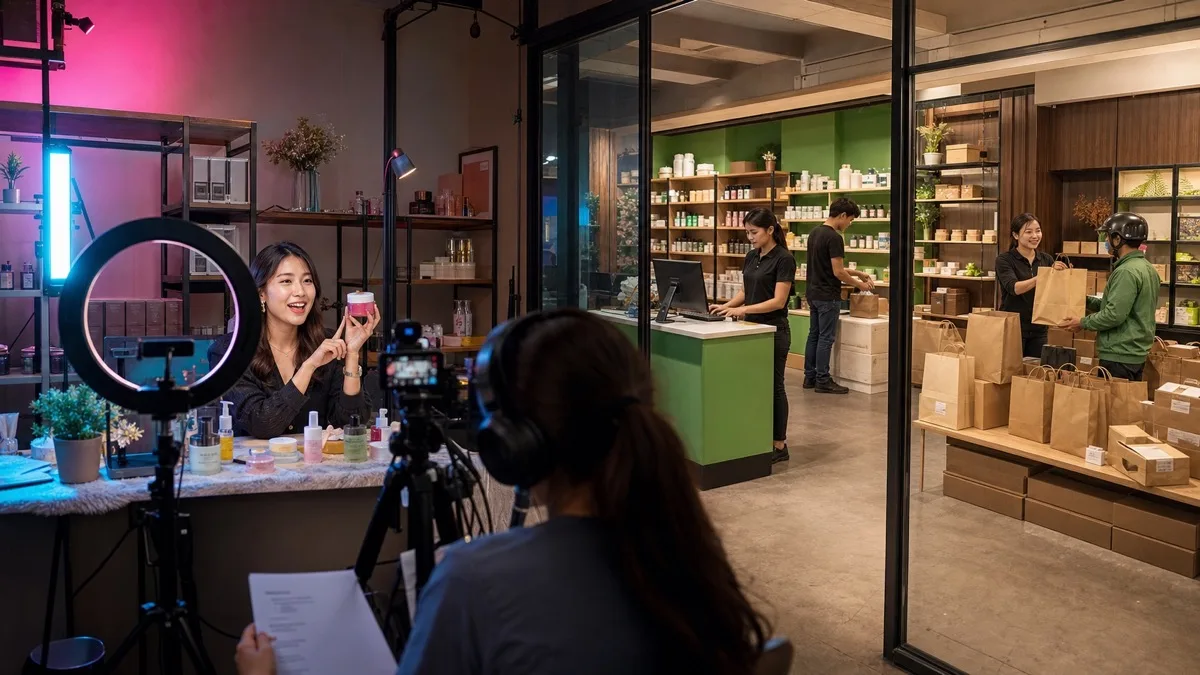
The core distinction: video-led acquisition vs owned commerce
- TikTok Shop is a video-led marketplace. Sellers create short-form videos and live streams that demo products. Viewers tap a product card mid-video, mid-Reel, or mid-livestream and complete the purchase inside the TikTok app. The platform brings the eyeballs (the For You algorithm), takes a commission on every sale, and keeps the customer relationship — order chats, dispute resolution, and re-engagement happen inside TikTok's surface, not yours.
- WhatsMenu is your owned storefront. Customers find it through your bio links, QR codes, WhatsApp, Instagram, Google Business Profile, and your own marketing. They check out at a real branded storefront with 20+ payment gateway options, get a WhatsApp confirmation, and join your customer list — not the platform's.
TikTok Shop catches the impulse from a viral moment. WhatsMenu turns it into a customer.
Side-by-side comparison
| Dimension | WhatsMenu | TikTok Shop |
|---|---|---|
| Type | Hosted catalog and ordering platform (your storefront) | Video-driven marketplace inside the TikTok app |
| Where it lives | Your domain (your-name.whatsmenu.page or custom) |
Inside TikTok — Shop tab, video product tags, Live shopping |
| Cost | Flat SaaS subscription | Free to list; commission per sale (~2–8% depending on country, category, and seller program); transaction/payment fees on top |
| Discovery | You drive traffic (Instagram, WhatsApp, Google, QR, paid) | TikTok algorithm — For You feed, Live, search, hashtags |
| Live shopping | Not native (you can stream on TikTok / Instagram and link to WhatsMenu) | Native and dominant — TikTok Live Shopping is one of the strongest live-commerce surfaces globally |
| Catalog depth | Full — categories, options, variants, bundles, stock, custom item fields, scheduled orders | Solid for products: variants, stock, basic options; weaker for services, dine-in, bookings |
| Cart / checkout | Native cart and checkout on your domain | In-app checkout inside TikTok |
| Payments | 20+ direct gateways (Stripe, PayPal, Razorpay, Billplz, Chip, HitPay, Mercado Pago, Paystack, etc.) | TikTok-managed payments via partner processors; sellers get a payout, not direct gateway control |
| Customer data | Yours — phone, email, address, order history, right to message again | TikTok's — buyer details masked or limited; communication runs through TikTok's chat |
| Branding | Full — logo, colors, custom domain, layout | Limited — products inside TikTok's interface, surrounded by competing creators and rival sellers |
| WhatsApp notifications | Native — confirmations, status updates, operator alerts | None — order updates inside TikTok app |
| Multi-industry | Retail, food, services, health, real estate, auto, vCards, B2B | Primarily physical product retail and FMCG; services and dine-in not native |
| POS / operations | Native cloud POS, kitchen display, drivers, reservations | None — TikTok handles its own logistics flow |
| Logistics | Your gateway, your delivery (Lalamove, Detrack, Drivers app) or pickup | TikTok-integrated logistics (TikTok Logistics, partner couriers); fulfilment policy controlled by platform |
| Returns / disputes | You set the policy | Platform-mediated; outcomes often favour buyers |
| Account risk | Your store, your terms | Account suspensions and policy changes happen; algorithm shifts can crater visibility overnight |
| Marketing engine | Coupons, bundles, share-cart, promo cards, pop-ups, carousels — included | Platform vouchers, flash sales, affiliate program, TikTok Ads |
| Geographic availability | Worldwide; especially strong in Asia, LATAM, Middle East | 16 markets as of 2026: US, UK, Germany, France, Italy, Ireland, Spain, Thailand, Indonesia, Malaysia, Singapore, Mexico, Vietnam, Japan, Brazil, Philippines (expanding) |
| Best for | Owning the customer relationship, services, repeat business, multi-channel, operations | Content-led discovery for visual/impulse products in supported markets |
The economics — same shape as Shopee/Lazada
Take a Malaysian or Indonesian seller doing RM 30,000 (or equivalent) per month on TikTok Shop:
On TikTok Shop:
- Commission (~2–8% depending on category and seller program): RM 600–2,400
- Transaction / payment fee (~2%): RM 600
- Voucher / campaign cost-share (varies): RM 500–1,500
- Platform cost: ~RM 1,700–4,500/month
- Plus: customer data is TikTok's; repeat-purchase economics depend on the algorithm finding the buyer again
- Plus: pricing pressure since competitors are visible side by side in the Shop tab
On WhatsMenu:
- Flat subscription
- Gateway fees (~2%): RM 600
- Total: subscription + RM 600 in gateway fees
- No commission, no campaign tax
- Customer phone/email yours; next month's repeat order costs you nothing additional
The math, like all marketplace comparisons, gets dramatically more favourable to WhatsMenu on the second and third purchase from the same customer. Marketplaces tax repeat buyers indefinitely; WhatsMenu doesn't.
Where TikTok Shop pulls ahead
Live commerce is genuinely category-defining
TikTok Live Shopping is currently the strongest live-commerce surface in many markets — particularly Southeast Asia, where livestream selling has matured into a primary sales channel for fashion, beauty, FMCG, and household goods. Streamers demo products, viewers buy without leaving the stream, the algorithm pushes the live to relevant audiences. WhatsMenu doesn't replicate this; nothing else really does.
Content-led discovery for visual products
If your product is visual and your team can produce content — fashion, beauty, gadgets, kitchen tools, snacks — TikTok's For You algorithm can put you in front of millions of buyers without traditional ad spend. A single viral video can move months of inventory. That distribution is a real advantage and not something an owned storefront can manufacture.
Built-in affiliate / creator marketplace
TikTok Shop's affiliate program lets thousands of creators promote your product in exchange for a share of the sale. For commodity retail, this is a powerful sales force you don't have to build yourself.
Native to where attention already is
Customers on TikTok don't want to leave the app. In-app checkout completes the loop without context-switching — friction is near zero for a viewer who just watched a 15-second product demo.
Free to list
No upfront cost. Sellers absorb commissions and campaign costs only when sales happen.
Where WhatsMenu pulls ahead
You own the customer
Same point as every marketplace comparison, and it matters most here because TikTok shoppers are highly impulse-driven — they came for the video, not your brand. Without a way to follow up on your own channel, that buyer disappears back into the algorithm. On WhatsMenu, every order gives you the customer's WhatsApp number; the next purchase is a message, not a hope-the-algorithm-shows-them-again.
No commission on every sale
TikTok Shop's commission, transaction fees, and voucher pass-through stack the same way Shopee/Lazada's do — typically 5–15% all-in for active sellers. WhatsMenu charges a flat subscription. For repeat buyers especially, the marketplace tax is permanent.
Real catalog for non-visual or service businesses
TikTok Shop's catalog is built around photogenic physical products. Services (salons, clinics, repairs), dine-in, reservations, vCards, real estate, B2B — these don't fit the "tap to buy from a video" model. WhatsMenu has dedicated flows for each.
Operations: pickup, delivery, drivers, kitchen
Pickup, local delivery zones, in-house Drivers app, Lalamove, Detrack, kitchen display, floor plan, daypart menus — none of this exists on TikTok Shop. WhatsMenu is built for the operations side, not just the listing.
Works in countries TikTok Shop doesn't
TikTok Shop is live in roughly a dozen markets and expanding, but many countries (Brazil, Mexico, India, large parts of Africa and Europe) don't have TikTok Shop yet. WhatsMenu works everywhere.
No platform risk
TikTok account suspensions, policy changes, and the platform's broader regulatory exposure (notably in the US) are real risks. Owning your storefront is the hedge. WhatsMenu doesn't go away because a regulator does.
Multi-channel by default
Your WhatsMenu catalog is the same whether the customer comes from TikTok, Instagram, WhatsApp, Google Business Profile, or a QR code. TikTok Shop only works for buyers inside TikTok.
The smart strategy: run both
Like Shopee/Lazada, the question isn't "WhatsMenu or TikTok Shop" — it's "what job does each channel do?"
- TikTok Shop = content-led customer acquisition. Use videos, lives, and the affiliate network to bring strangers in. Treat the commission as a paid-acquisition cost.
- WhatsMenu = customer retention and operations. Once a buyer has discovered you on TikTok, capture them on your owned storefront for the next purchase. Drop a thank-you flyer in the parcel pointing to your WhatsMenu URL. Update your TikTok bio with the link. Run loyalty and WhatsApp follow-ups that only work on your direct channel.
For service businesses — salons, clinics, repair shops, real estate, food trucks, vCards — TikTok Shop isn't even structurally relevant. Use TikTok organically (videos and lives without the Shop) to drive traffic to your WhatsMenu storefront, since TikTok Shop's catalog model doesn't fit non-product offerings.
When WhatsMenu is the right choice
- You're a service business — TikTok Shop's product-card model doesn't fit your offering.
- You operate where TikTok Shop isn't available.
- You sell mostly to repeat customers, where commission on every sale is a permanent tax.
- You want to own the customer relationship — phone, email, WhatsApp follow-up.
- You sell non-visual products (B2B, regulated goods, real estate, professional services) where video commerce isn't natural.
- You want branded checkout on your own domain, not inside TikTok's interface.
- Your customers prefer WhatsApp over in-app TikTok chat.
When TikTok Shop is the right choice
- You sell visual, impulse-friendly products (fashion, beauty, gadgets, FMCG, snacks).
- You can produce content consistently — videos, lives, demos.
- Your business is in a TikTok Shop market (SEA, UK, US, expanding list).
- You want to leverage the affiliate / creator network to scale without ad spend.
- Your margins absorb 5–15% in platform costs comfortably.
- You're optimising for first-time buyer discovery, not repeat-customer LTV.
Frequently asked questions
Should I use TikTok Shop or WhatsMenu?
For most product retailers in TikTok Shop markets: both. TikTok Shop for content-driven discovery, WhatsMenu for the customer relationship after that first sale. For service businesses or merchants outside TikTok Shop's geography: WhatsMenu alone.
Can I link my TikTok bio to WhatsMenu?
Yes. TikTok lets business accounts add a website link to their profile. Paste your WhatsMenu storefront URL there. Use TikTok organically for content — even if you also run TikTok Shop — to drive traffic to your owned destination.
Can I use TikTok Live without TikTok Shop?
Yes. You can run TikTok Lives that promote your products and link viewers to your WhatsMenu storefront via the bio link, on-screen overlays, or call-to-actions. This is the typical play for service businesses or for sellers in countries where TikTok Shop isn't live yet.
What does TikTok Shop actually charge?
Commission rates vary by country, category, and seller program — typically 2–8% as a base, with additional transaction/payment fees and voucher pass-through. Total platform cost for active sellers commonly lands in the 5–15% range, similar to Shopee and Lazada.
Can I move my TikTok Shop customers to WhatsMenu?
Not directly — TikTok hides buyer phone numbers and emails the way Shopee and Lazada do. The path: include a thank-you card in each parcel pointing to your WhatsMenu storefront, add a WhatsMenu link to your TikTok bio, and use loyalty hooks (a discount code on your direct site) to incentivise the second purchase outside TikTok.
Does WhatsMenu replicate TikTok Live Shopping?
No — there's no native live-commerce engine on WhatsMenu. The workaround is to stream on TikTok, Instagram, or Facebook Live and direct viewers to your WhatsMenu catalog via the bio link or on-screen prompts.
Is TikTok Shop available in my country?
As of 2026, TikTok Shop is live in 16 markets: Indonesia, Malaysia, Thailand, the Philippines, Vietnam, Singapore, Mexico, Brazil, Japan, the UK, the US, Germany, France, Italy, Ireland, and Spain — with further European markets (Belgium, Netherlands, Poland, Sweden) on the announced roadmap. If you're outside the supported list, the question resolves itself — TikTok Shop isn't yet an option in your market, and a WhatsMenu storefront is the practical path.
Can I list the same products on TikTok Shop, Shopee, Lazada, and WhatsMenu?
Yes. There's no exclusivity requirement. Most multi-channel sellers maintain identical SKUs across all marketplaces and their own WhatsMenu storefront — typically with WhatsMenu prices slightly higher (no commission to absorb) and direct-channel customers buying for reasons other than rock-bottom price.
Will my WhatsMenu storefront affect my TikTok Shop ranking?
No. TikTok Shop ranks based on its own engagement and conversion signals inside TikTok. Running an external storefront is unrelated to your in-platform performance.
Can I run TikTok Pixel on WhatsMenu?
Yes. WhatsMenu supports TikTok Pixel, Facebook Pixel, and Google Analytics — feeding conversion events back to TikTok's ad platform if you run TikTok Ads pointing at your WhatsMenu storefront.
Bottom line
TikTok Shop is excellent at one job: turning short-form video and live streams into product sales for visual, impulse-friendly products in supported markets. Live commerce, the For You algorithm, and the affiliate network are real advantages no owned platform replicates.
WhatsMenu is excellent at a different job: hosting the real catalog and owning the customer relationship. Repeat buyers, services, dine-in, multi-industry fit, WhatsApp confirmations, real branded domain, operations — all things TikTok Shop won't do.
For product sellers in TikTok Shop markets, run both: TikTok Shop for the introducing, WhatsMenu for the keeping. For services, non-visual businesses, or merchants outside TikTok Shop's geography, WhatsMenu alone is the right answer — with TikTok used organically (videos and lives without the Shop) to send traffic to your owned destination.
Get started at whatsmenu.page/new.